Saturday, 11 July 2026

Falling Back - Lurching Forward

"For what its worth: its never too late or, in my case, too early to be whoever you want to be. There's no time limit, stop whenever you want. You can change, or stay the same, there are no rules to this thing"  F.Scott Fitzgerald - The Great Gatsby

I guess as we age we reminisce more and look back, as there is more back than forward. I do a bit of that these days. I also do look forward quite a bit as there is I hope quite a bit of it left! I am goal oriented needing a progression or something to aim forward at. Preferably without a ball, but certainly needing engagement. My teachers at school certainly thought I had a short attention span. But I didn't I was just bored with rote learning.  Primary education was fairly strict in our wee Highland village school St Mary's Episcopal. At St Mary's you got the three "R's" or the belt, often times both.  In fairness I could be a wee shite but aren't all boys now and again when bored. We had some Gaelic and minor Scottish history at school in among the revisionist clap trap of glorious English history, 1066 and all that. Its not so much that Scottish history was ignored, it just seemed a footnote to the Great British empire and revisionist myths. Little did we realise at the time that our history and culture, Neolithic, Celtic, Dalriadan, Celtic Warrior Priests, Vikings, Jacobite's and Scottish enlightenment was both our local and National history that had far reaching influence, European and World. Darien to the Heights of Abraham, Hanseatic League to the Somme and the extirpation of the menfolk of the Cabrach. 

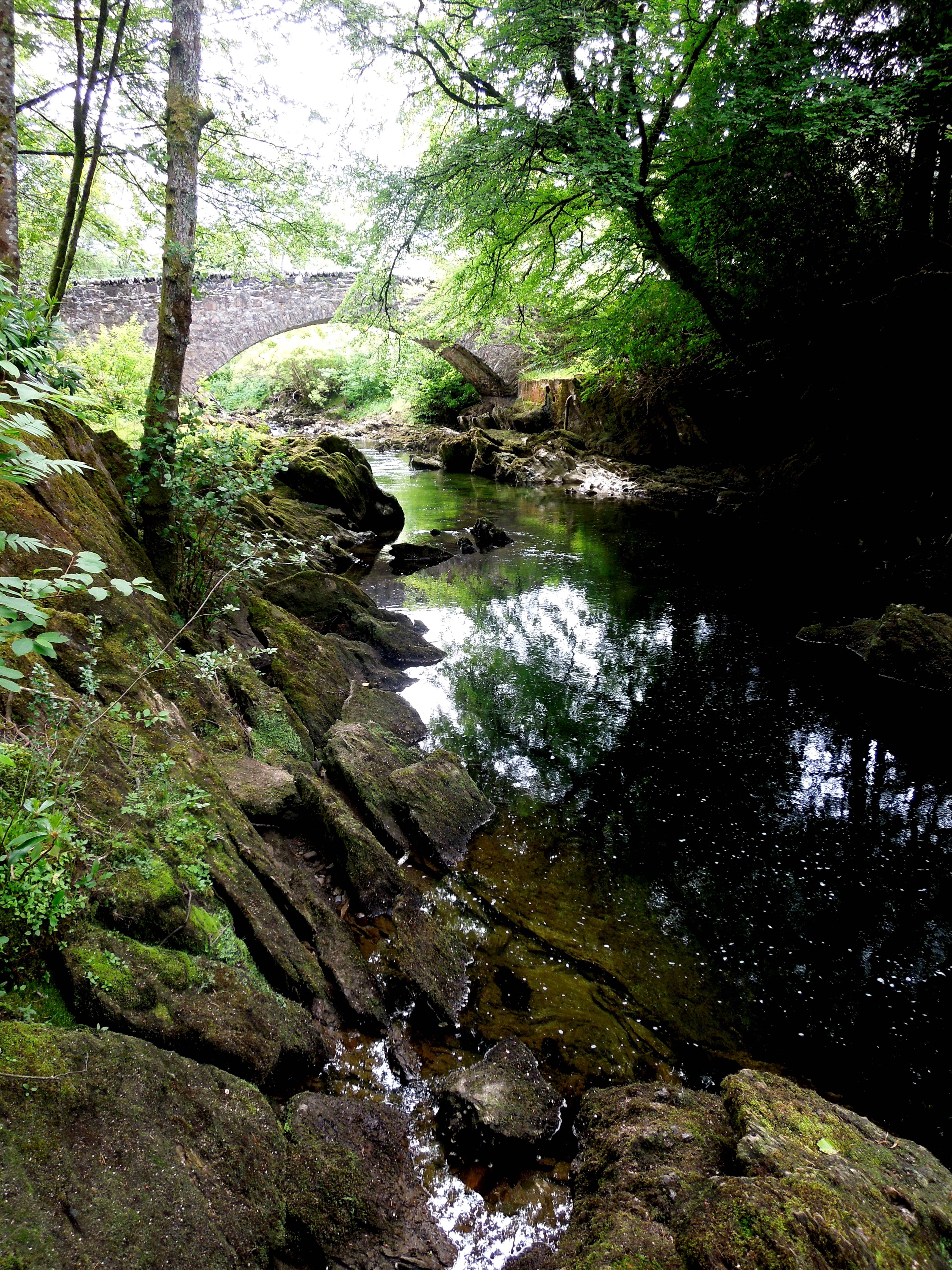
Secondary School up the road at Kinlochleven was just a travail among some burnt out bullies for teachers and de motivated kids. For me it was class room days of longing to be out with a fishing rod on a hill loch or wandering the river. I had not read "Highland River" by Neil Gunn then, but later on reading it I found Kenn the protagonist and I shared many childhood wonderings and wanderings. The source for me was always high in the mountains of the Glen. Filling me with terror and longing at the same time.  Highland River is a quest. The salmon symbolising knowledge from the Druid/Celtic mythology of An Bradán Feasa. Fishing was and still is a wander with a rod. Less about what you catch (these days I put them back if I can) and more about what you feel see and think along the way - perhaps an enlightenment. I can partly be defined as an angler, and I hope now also a conservationist. 

The source for Kenn on high moorland, for me up high among austere Dalriadan rock and Andesite. When exotic "climbers" such as Ian and Nicki Clough bought an old house to do up in the village I got my first exposure to folk who went up into the mountains as climbers. As a clueless teen along with another local lad we started exploring these high places and had adventures. I became a hillwalker and wannabe climber. Several adventures and misadventures later I was in the mountain rescue team. I was still very much a wannabe climber and in no way competent enough, but folk were patient and I got strong. Then, and for several years after, the team were working hill men and climbers who went on rescues. It was fairly informal and just expected that you or a competent visiting climbing friend would help out if someone was in trouble. Later as I became a better mountaineer and rescues became frequent it became less informal, and to meet the improvements in pre hospital care mountain rescue also changed. I also discovered I was a wee bit cleverer than my teachers had indicated and entered adult education with a gusto never felt in my younger days when I bailed out of school at 14 and didn't go back.  No regrets. Carpenter, Lumberjack, Mountaineering and Ski Instructor, Paramedic, Husband and Father. Success in life isn't money, property or status. Its only quantifiable in love. The more pain love causes in its loss the more depth it has. Learning to embrace that is a spiritual journey. Only loss of love, grief and pain awakens us to how fragile we all are, how little material goods matter and that money is a token.

I write. Probably not very well. Some are tales of rescue and of its great characters and legends. I still rescue day shift as a ski rescuer working ski patrol with a group of great folk up at Glencoe Mountain. Every time that damn helicopter fly's over I wonder what's happening with the MRT and think of the new young stalwarts of the team, remembering getting my head around the trauma and relating it to my own ambitions on some of the same climbing routes of the fallen. MR can stealthily grip and steal away the mountaineer, substituting a trauma junky. Pedalling the hit of helicopters, kudos and the excitement of the unknown. As potent as heroin to the adrenaline junky of which I was and maybe still am one.

I do feel very much a climber again even if it's clipping bolts or several grades down my old trad abilities.  I love wandering with a rod or exploring an old coffin route on a mountain bike. We are the sum of all past things, but it does not mean a future only looking back along some cursus of where we have come. Does it?

Be it a journey of the mind or a piece of rock there is plenty out ahead if you reach for it. That reaching  is a hard journey but I have light ahead up on that magic mountain.

“The world is a mountain. Whatever you say, it will echo it back to you. Don't say, 'I sang nicely and the mountain echoed an ugly voice!' That is not possible” Rumi

Friday, 10 July 2026

Sunset Song Revisited

I recently reaquainted myself with "A Scots Quair" by Lewis Grassic Gibbon (Leslie Mitchell). I first read these books more than fifty years ago. Sunset Song without doubt my favourite and a book worth delving into again and again. Having time now to really understand its nuances. Communities, particularly rural and farming communities are inextricably bound to nature which in days gone by sustained them by providing food from land, hill, sea and river. Both work and the season of farm life are used in Sunset Song as metaphors for the physical, emotional and spiritual growth of Chris Guthrie as a woman, as well as giving us insight into the harsh physical work each season entailed, and how the farmer had to work with nature and have the support of the community to survive.

The harsh nature of living off the land, and the sense that close farming neighbours such as Long Rob of the Mill, Chae Strachan, and even Munro were in the same boat created a community of close neighbours who at times could judge each other harshly yet would not hesitate to help one another in a crisis. Kinraddie itself was part of the greater community at large but not so intimate as around Blawearie. The fire at Peesies Knap brought out the best in this intimate community where you would give aid to a neighbour. They were all dependant on each other for mutual aid at times of hard work, especially at harvest, where if the weather was favourable the work had to be done quickly and efficiently while the weather held. This sense of community was based not on only on work but also trust and closeness built on friendship for each other, despite the common failings of folk and their tongues as portrayed in the book.


The standing stones are a recurring theme in Sunset Song. The stones were probably Pictish of which there are quite a few to be found in farming areas. Where there is more than one stone, some say that you can measure the lunar cycle. The mystical tie between ancient culture, nature and man is felt by Chris who uses the stones and the loch as a sort of retreat and thinking place. Interestingly her father who comes over in the novel as a strict Presbyterian, who threatened Will Guthrie with violence for saying “Come over, Jehovah (p.30) to Bess the horse after he groomed her, seemed to dislike them, perhaps for what they represented? “And he glanced with a louring eye at the Standing Stones and then Chris had thought a foolish thing, that he kind of shivered, as though he were feared, him that was feared of nothing dead or alive, gentry or common.”


Communities that are close to the land or sea, can be identify and believe in more than one spiritual concept. Christianity and superstition often blending into each other. The ancient and modern Scots were/are no different, and perhaps this is what Gibbon is getting at in the book. John Guthrie chooses his Calvinist blind obedience over the mystical and timeless spirit and tie with nature and season emanating from the stones. Perhaps his jealous god and the beating life gives him in making a living make him resent the very nature with which he must work in harmony. Ironic that he should dislike them as this was the people he possibly came from. Perhaps as in Highland River, where Neil Gunn asked where the Picts went? and suggests all we need is to look in a mirror and we will see.


Not all nature is portrayed as harsh in Sunset Song though. “Below and around where Chris Guthrie lay the June moor whispered and rustled and shook their cloaks, yellow with broom and powdered faintly purple, that was the heather but not the full passion of its colour yet.” Although times could be harsh, each season has its beauty in nature, and you can smell summer in this quote. Often the prose relating to nature and season were placed alongside the growth both spiritually and sexually of Chris. Drilling has perhaps some of the best prose in the book. Nature, its smells and whole evocative feeling of a good autumn night during the “harvest madness” weaves around the awareness of Chris that she is no longer a girl and has become a woman “growing up limber and sweet, not bonny, perhaps, her cheek bones were over high and her nose over short for that, but her eyes clear and deep and brown, deep and clear as the Denburn flow, and her hair was red and was brown by turns, spun as fine as a spiders web, wild, wonderful hair”.


Later in the novel, Kinraddie community life turns nasty when Long Rob decides he will not join the army. Assumptions are made that he is a coward or a conscientious objector and the community turns against him. Communities tolerate eccentricity up to point, but only for some, failure to conform to the norm, or going against the majority often turns the community from a benign social group into something nasty as was the case for Long Rob. Rob is no coward but a man of conviction. Both he and in particular Chris, struggle with identity. She is both Chris of the Howe, and Chris of the books and learning. Caledonian Antisyzygy* There is an undertone of the struggle between conforming to be part of the community, and the individual who if they step out of the social norm will be excluded and pulled to pieces by wagging tongues. Rob bowed to pressure from within himself. At least he went to war on his terms.


The effect of the Great War on small farming communities was devastating, and most never fully recovered. The eulogy for the fallen by Robert Colquohoun in the Epilogue describes this, and the tie with the land and nature. “And who knows at the last what memories of it were with them, the springs and the winters of this land and all the sounds and scents of it that had once been theirs, deep and a passion of their blood and spirit, those four who died in France.” This illustrates the tie between land, nature and community as for what else were they fighting other than what they perceived as a threat (from government propaganda) to their families and community. “Chae looked at young Ewan and said Ay, man! And he told them “they’d brought out a fine bit bairn between them, every man might yet have to fight for bairn and wife ere this war was over;”


Even at the last Gibbon emphasizes the feel and smell of nature and the pull of community. When Chae spoke to Ewan on the morning of his execution for desertion he asks, “But why did you do it Ewan?”


Ewan replies. “It was that wind that came with the sun, I minded Blawearie, I seemed to waken up smelling that smell. And I couldn’t believe it was me that stood in the trench; it was just daft to be there. So I turned and got out of it.”


And then Ewan said, sudden like, it clean took Chae by surprise, “Mind the smell of the dung in the parks on an April morning, Chae? And the pewits over the rigs? Bonny they’re flying this night in Kinraddie, and Chris sleeping there, and all the Howe happed in mist.”


and the standing stones up there night after night and day after day by the loch of Blawearie, how around them there gathered things that wept and laughed and lived again in the hours before dawn, till far below the cocks began to crow in Kinraddie and the day had come again”


In the end, despite all life can throw her way, the indomitable Chris moves forward with her life but does not lose her sense of being bound to nature and the seasons. She accepts the way of folk in a community but ploughs her own furrow through life.


*Caledonian Antisyzygy is basically the joining of opposites. Some have argued argued that this 'union of opposites' forms the basis of Scottish literature. Take Glencoe as a landsacape example. Glen of Weeping and dark gloom. Valley floor of green pastoral fields and clean sparkling water. Without the mountains mist and rain the fields would be barren.

Thursday, 9 July 2026

Wee Fella

With his hands in his pockets and cap askew the wee fella wanders up the village street. If street it could be called. A single thread of narrow potholed tar stretches from crossroads to arched bridge, passing two wee shops and the green hut of Annabel the post mistress. A walk only to peer over the old humpbacked bridge to see if a Salmon had made it over the falls this tide to rest under the big rock where a worm could be dangled before its neb. Nothing resting there today.

Life was free, simple and uncomplicated, and all that was on the wee fellas mind was these leapers of waterfalls and figuring out how he might catch one. If not the silver traveller Salmon, then the elusive ancient trout in the lake of the old Strathcona estate. Big Loch Leven trout and Rainbows from a stocking seventy years past. Peaty black and huge, these monsters were hard to tempt. If an Islay malt gets its flavour from peaty phenols then these trout were marinated in them. Lay them on a bed of grass and the darkness came away from their skin and beautiful silver trout revealed underneath, with the pink slash along the side of the rainbows seeming exotic. They say there is only one lake in Scotland. There was one here too, until the locals passed away or left, and incomers called it a lochan.

He walked up to the old boat shed, a voyager canoe decaying in its midst, the paths around the lake covered by thick rhododendron almost impassable. A lake where he imagined the young Métis Isabella, paddled away her unhappiness with the Scottish weather. No matter that Donald her husband had tried so hard to bring Canada to her with his creation.

He wandered back by Invercoe and onto the loch shore common grazing. Looking out onto the sea loch and its Islands feeling belonging, and sense of wonder to life. A life of potential outcomes and what he might become when released from the torpor of a classroom. Not knowing then that childhood was mostly all gains, and to come adulthood and loss.

He picked up a pebble

and threw it into the sea.

And another, and another.

He couldn’t stop.

He wasn’t trying to fill the sea.

He wasn’t trying to empty the beach.

He was just throwing away,

nothing else but.

Like a kitten playing

he was practicing for the future

when there’ll be so many things

he’ll want to throw away

if only his fingers will unclench

and let them go.

“Small Boy” by Norman MacCaig

Tuesday, 7 July 2026

New Book "Between a Loch and a Hard Place


Book £12.95

Postage £3.30 1st Class Royal Mail

email davygunn@gmail.com with your address if you would like a copy. I will reply with payment details

The author was born in Oban and brought up in the village of Carnoch, better known nowadays as Glencoe village. A Highland upbringing rich in community. Glencoe is an area steeped in bloody history, surrounded by mountains and cut through by the River Coe. Known for its infamous 1692 massacre, Glencoe is also famed for its mountaineering, with people coming from all over the world to climb its majestic peaks and test themselves on its rock and ice climbs. Glencoe Mountain Rescue Team has a long history of saving lives and of rescue from the West Highlands and has had a few of Scotland’s best mountaineers as members. Not least was one of the rescue team founders, Hamish MacInnes.

This book gives some local history and insight into how a Highland boy lived beside a river that gave quietude and wonder as its silver leapers, the Atlantic salmon, forged up through its foamy waters into the mountains. And where the boy, me, was to meet mountain folk who opened his eyes to a broader world and possibilities. This book is about my upbringing, and the community of Glencoe that formed me. The reader may find the climbing and rescue tales a bit technical as I have used the terms and technicalities of the sport. The same is true for skiing. Forgive me as it’s hard to convey some of these ascents and descents without these technical details. Skip past bits if necessary and just enjoy the book as a collection of impressions and short tales.

The River is the thread

Running stitches through time

Gathering mountains, forests and sea

And binding me to this land

Lucy Morrice


Thursday, 25 June 2026

The Dash. The Span of our Life

This last two years has had some moments, not least getting back fit after a new hip. It was harder than expected, especially as I had a setback from trying to climb the ski mountain in snow two months after the operation. Diminished is how I seemed to those who know me. Lately I have been trying to undimish myself, and thankfully I am almost back to fully fit, and getting quite strong. The physical setback had quite a profound effect on my mental health but that is now also healing. Perhaps its these hurts and setbacks, the losses, the downs that teach us the biggest lessons. Somehow we get up again. I want to live better, and more gently on this small planet. I want to love those close to me, family and friends. And be more active against injustice and ecocide. But sometimes that is daunting in the face of current politics and changes in society.

How we live and what we leave as legacy of our short years on this little planet was recently brought home by the brevity of a gravestone. An entire lifespan condensed to a dash between birth and death. The birth and end dates can, sadly, be too close for some who left this earthly place far too soon. The dates mere bookends to life. The dash between matters, it’s a life, and it’s going to be our eulogy. That tiny little mark and it's span should be lived well and filled with love and gratitude. At the end that is all there is to life. Two dates conjoined by a little mark. The love you gave and received the only after life. Dates and a dash chiseled on your temporal stone. Time erodes, moss covers and we are forgotten.

“In three words I can sum up everything I've learned about life: it goes on.”