A workout I often have athletes do is a combination of intervals followed by a steady-state tempo. What happens on the steady state tempo says a lot about the athlete’s aerobic fitness.
Here you see a run chart and a bike chart from a single duathlete. The charts are from WKO+ software. He did the run workout first and then the same day did the bike session. Each session involved a warm–up, intervals (pink stripes), a recovery following the intervals, a steady-state tempo (green stripe), and a cool down. Heart rate is the red lines on both charts. Run speed is the blue line. The back line is bike power. This athlete has greater experience as a cyclist than as a runner and his bike fitness tends to exceed his run fitness. This also shows up in his approach to each session.
RUN
In this chart (click to expand) he was doing 800m intervals on a track at just a bit slower than his 5k but faster than 10k pace. After each interval he did a 200m jog to recover. Each recovery was just slightly shorter in duration than the preceding work interval. Notice how he started each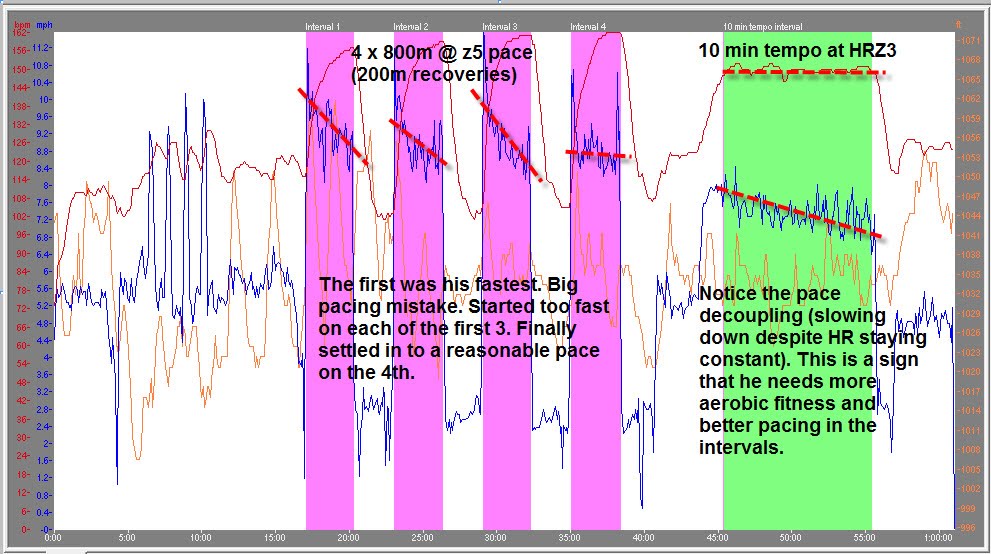 work interval at the fastest pace of the interval and gradually slowed down with the exception of the last where he finally settled in to a good pace initially. And he gradually got slower on each subsequent interval with the exception of the third which was his second fastest (but had the greatest pacing variability). I believe this positive-split pacing (start fast, finish slow both within and between intervals) is, in part, reflective of his more limited experience as a runner.
I was also very interested in his 10-minute, heart rate zone 3 tempo run following the intervals. Besides making for a great workout, I do this to see how aerobically fit the athlete is. Near the end of a challenging workout finding how speed responds when heart rate stays constant is a good indicator of the athlete’s aerobic fitness. Here you can see that speed drops off. Heart rate and pace ‘decoupled.’ They are not parallel. He has more work to be done on aerobic fitness yet which is all the more reason to be very cautious with pacing early in a race. Going out too fast will cause a significant drop in speed later in the race. If his aerobic fitness was higher, pacing would not be quite as much of a problem.
BIKE
Here you see his bike workout with 5-minute intervals done at power zone 4 which is roughly 40km time trial power for him. Th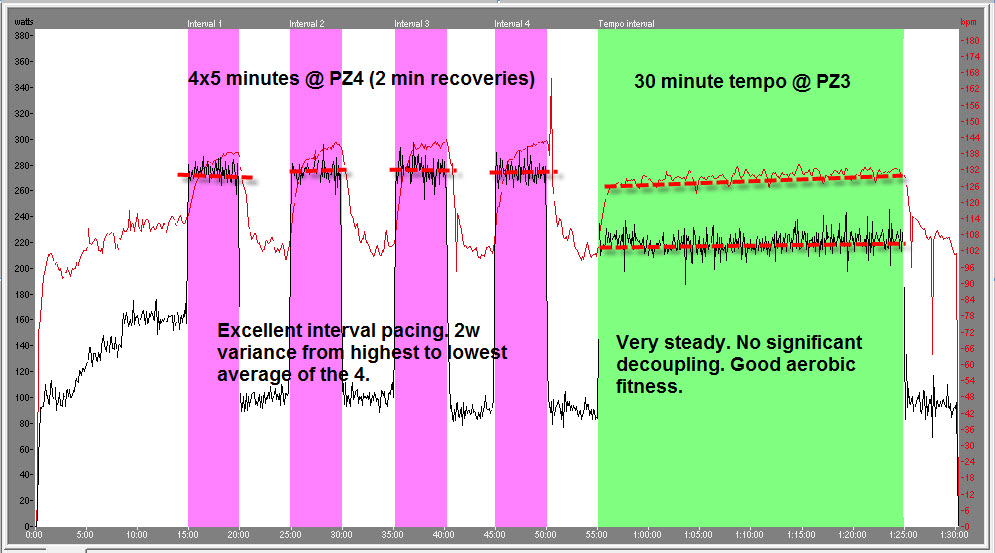 e recovery intervals were short at about two minutes each. Notice how beautifully he paced the intervals. They are steady and consistent. As a coach, this is so beautiful it brings tears to me eyes. :)
Then notice how steady his 30-minute, power zone 3 tempo was. The two lines (heart rate and power) remain nicely 'coupled,' just like railroad tracks. His aerobic fitness on the bike exceeds his run aerobic fitness.
It’s apparent we still need to work on two things: run pacing and run aerobic fitness. He has made great gains as a runner. Had he done this same run workout a few weeks ago the decoupling would have been much more evident. And his running race times at 5km indicate that he is, indeed, making great progress. Stellar run performance takes a long time to achieve, as in years, but his progress has actually been quite exceptional due to his determination and discipline.
Thursday, 27 August 2009
From Joe Friels Blog


Sunday, 16 August 2009

Chrondromalacia Patellae
Chondromalacia patellae (CMP) results from damage to the cartilage which covers the posterior aspect (back) of the patella (knee cap). This is known as articular cartilage and acts to allow smooth movement and shock absorbtion between the patella and the groove through which it runs (formed by the Femur and Tibia).
The cause of this damage can be either acute or due to a long-standing overuse injury. Acute injuries normally occur when the front of the knee cap suffers an impact, such as falling directly onto it, or being hit from the front. This results is small tears or roughening of the cartilage.
In overuse cases, the cause of the damage is usually repetitive rubbing of part of the cartilage against the underlying bone. In a healthy knee the movement of the Patella across the knee is a gliding, smooth movement. In individuals with CMP, the knee cap rubs against the part of the joint behind it, resulting in inflammation, degeneration and pain. The can be for a number of reasons, but is usually due to the position of the patella itself.
The most common feature of condromalacia patellae is patella mal-tracking. The patella most commonly runs too laterally (to the outside) in the groove. This problem is most regularly caused by muscle imbalances, where the lateral quadriceps muscles and other tissues such as the retinaculum are too tight and the vastus medialis oblique muscle is weak.Other structural problems include Patella alta, which refers to a high patella and patella baja which refers to a low patella.
Chondromalacia patellae is common in young athletes who are often otherwise injury free. Its incidence is also highest in females due to their on average higher Q angle. CMP is also more common in those who have experienced previous traumatic knee injuries such as fractures and dislocations.
CMP is often confused with PatelloFemoral Pain Syndrome (PFPS) as CMP is regularly a result of PFPS. However, they can both occur in isolation.
What are the symptoms of Chondromalacia Patellae?
- A grinding or clicking feeling when straightening the knee (known as crepitus).
- Pain at the front of the knee.
- Pain which is often worse when walking downstairs.
- Pressing down on the knee cap when the knee is straight may be painful.
- Pain when standing after extended periods of sitting (movie-goers knee).
Heart Rate Calculator

Astana Announce Team for the Tour of Ireland
Yaroslav Popovych is a very experienced professional having ridden all three Grand Tours including this year’s Tour de France where Armstrong finished in third place on the podium next to his team mate and race winner Alberto Contador. Popovych won the young rider classification in the Tour de France in 2005 and he finished 12th overall.
Haimar Zubeldia from Spain is certainly no stranger to stage races having ridden the Tour de France nine times. He was part of this year’s team who won the stage 4 team time trial.
Janez Brajkovic is the current Slovenian time trial champion who rode the Giro d’Italia with Armstrong this year finishing 18th overall. He also won the Tour of Georgia in 2007 and is a triple Military World Time Trial Champion. Michael Schar is a talented 23-year-old from Switzerland who is a triple National Time Trial champion at Junior and Under-23 levels.
Jose Luis Rubiera is the team climber who can be relied on for team support when the road starts to rise. He has ridden 20 Grand Tours and won two stages of the Giro d’Italia. Jesús Hernádez is the daily training mate of Tour winner Alberto Contador. He didn’t race in 2008 but has made a strong comeback in 2009. He started the season very early with Armstrong in the Tour Down Under. Armstrong calls him ‘Sweet Baby Jesus’.
The full team line up is:
Armstrong, Lance USA Brajkovic, Janez SLO
Hernández, Jesús ESP Schar, Michael SUI
Popovych, Yaroslav UKR Rubiera, Jose Luis ESP
Zubeldia, Haimar ESP